Monday, August 11, 2008

the sign of the beaver

Title: The Sign of the Beaver by Elizabeth George Speare

Genre: Historical Fiction

Annotation: A friendship between two young boys is forged in the vast wilderness of Maine during the latter part of the eighteenth century.

Review: Imagine celebrating your thirteenth birthday all alone amidst the wilds of colonial Maine, charged with protecting your family's homestead while they are on route to join you. Matt finds himself in just this situation when his father leaves him to retrieve Matt's mother and siblings from Quincy, Massachusetts. After a chance encounter with a unscrupulous white man who steals Matt's firearm, his only means of obtaining meat and his sole means of defense, the young boy might not have survived his six-month ordeal had it not been for the kindness of a local Penobscot Indian Chief, Saknis, and his grandson, Attean. These two Native Americans first come to the aid of Matt after he is swarmed by bees and sprains his ankle. Then, as payment for their help, Matt agrees to teach the English language to Attean. Sankis hopes that his grandson will learn enough of the white man's words to understand the treaties into which they are entering. However, throughout the course of their lessons, Attean ends up teaching Matt how to be self-sufficient in the forest. Their friendship continues to develop until the boys are threatened by a mother bear, which they must kill in self-defense. This act precipitates Matt's deeper enculturation into the native way of life when he is invited to the Indian settlement to celebrate the killing of the bear. Attean is then sent on a vision quest by his grandfather to find his spirit or manitou. This experience changes Attean, who is growing into a man. Eventually, the Native Americans decide to leave their home in Maine and head westward, away from the encroaching colonialism of the white man, to continue their hunter/gather way of life. This turn of events means that Matt will lose his boyhood friend, Attean, and be left to face the coming winter alone since his family's trek back to the homestead from Quincy was obviously delayed.

Set about five years after the end of the French and Indian War, we find out that Attean's mother and father were both killed by white men during this battle. The story also illustrates some of the cultural conflict between Judeo-Christian white colonists and Native Americans. For example, in one passage, Attean questions Matt about the white man's tendency to take ownership of the Indian's ancestral hunting grounds: "How can man own land? Land same as air. Land for all people to live on. For beaver and deer. Does deer own land?" The travesties committed against native peoples by white settlers are immense, and, in many ways, Speare does not go far enough in her criticism or condemnation of colonialism in North America. Yet, one interesting literary device is her use of the story between Matt and Attean to uncover the racism and the ethnocentrism in Robinson Crusoe, another adventure tale involving settlers and "savages." As Matt so astutely observed, "He remembered Robinson Crusoe and his man Friday. He and Attean had sure enough turned that story right about. Whenever they went a few steps from the cabin, it was the brown savage who strode ahead, leading the way, knowing just what to do and doing it quickly and skillfully. And Matt, a puny sort of Robinson Crusoe, tagged along behind, grateful for the smallest sign that he could do anything right."

Thursday, August 7, 2008

vampire breath

Title: Vampire Breath by R.L. Stine

Genre: Horror/Vampire

Annotation: When Freddie and Cara's rambunctiousness gets the best of them, the discovery of a vampire in their basement could lead to their demise in the future...and the past.

Review: Freddie Martinez is a fighter, not in a major sense of the word, but usually when it comes to showing his best friend and neighbor, Cara, who's boss. During a night of babysitting, the duo stumble upon a secret passage way in the basement of Freddie's house. At the end of an erie passageway, they stumble upon an empty room -- empty, save for a mysterious bottle that sits inside. The two discover that the bottle contains an ethereal substance called Vampire Breath, and once spilled, releases the frail, ancient vampire known as Count Nightwing. The count's thirst is great, and the one thing that Nightwing needs is the sustenance of his soon-to-be victims. Unbeknownst to Cara and Freddie, the Vampire Breath has many uses, and inadvertently transports the three of them back to the past, where the two friends must elude the clutches (and fangs) of Count Nightwing and get back to their own time.

R.L. Stine has always had an excellent talent for crafting stories for younger adolescents, and after reading Vampire Breath with a more "mature" set of eyes, I can remember why his books were so appealing to me and my friends. Even though the book is not substantial in length by any means, Stine's text has an urgency and speed to it that equates success in the teenage marketplace. Pages turned easily one after another as I sought to find out what would happen to Freddie and Cara. The suspense of the horror genre are exemplified in this vampire story; two young kids face a supernatural foe that must be vanquished lest they meet their doom in his clutches. In the back of one's mind, we have to assume everything will end all right, but the quickening pace of the author's prose urges us onwards with just a twinge of uncertainty. The story doesn't end as one would expect -- Stine punctuates Vampire Breath with a twist that only a Goosebumps novel can summon up.

While I do applaud this book for its entertainment value, but I do not think it is by any means award material. Stine's fiction in serial form beckons to slash fiction with little literary merit. I would encourage young people to read these books because of there fun, effortless feel. Vampire Breath easily illustrated challenges of establishing a more adult personhood, especially for Freddie. In the backdrop of fanciful situations, this teenage boy struggles to assert himself as powerful and independent, eschewing cowardice and rising up again "adult adversaries." Young adults can identify with characters like Cara and Freddie, and feel all the more empowered by them.

passionate plea: the diary of a young girl

When an atrocity such as the attempted annihilation of an entire group of people occurs in our global community, there is a duty to respect that grave injustice. The Holocaust is an example of such a program of hate that has marred the course of human events. History is unforgiving, and humanity must take what it can from the misdeeds and misfortunes of those who have gone before us.

Among the accounts that we have about the Holocaust today, Anne Frank's The Diary of a Young Girl gives us great insight into the life of Jews in hiding during World War II. It is difficult to imagine being confined to cramped quarters with seven other people for the duration of over two years. The residents of the secret annex at times had to deal with impoverish, unpleasant living conditions, with the lurking fear of being discovered and killed by the Nazis. It wrenches my heart to think of anyone having to be subjected to such an ordeal.

Here lies the significance of Anne Frank's diary: through her insight and observations, at heart she is still a regular teenage girl. Anne writes about her opinions of her classmates before going into hiding much like I would have described mine in middle school or junior high. Struggles with her parents exist, as well as the pangs of living with the van Daan family. Anne also experiences love for Peter, and reaches a maturity (both physically and emotionally) during her exile in the back quarters of her father's office building. This book is not just an account of the Holocaust - it is the account of the life of a young woman who is experiencing the life lessons & emotions that all other teens will feel. The universality of The Diary of a Young Girl makes it a book that teaches adolescents that there are things everyone will go through, regardless of their circumstances.

I hope you will vote for this monumental book. Anne Frank's diary deserves the honor of such an award, and today's youth deserve to be exposed to it.

passionate plea: a northern light

Having read Jennifer Donnelly's A Northern Light as one of the first selections for this semester, I keep returning to this book in the back of my mind. Donnelly has truly created a masterpiece of young adult literature in the story of Mattie Gokey. Despite taking place over a century ago, the life choices that this girl must make ring true even in the 21st century. Who cannot empathize with the struggle of duty? Every single one of us has had to weigh the needs of others against our own, and the universality of this message makes A Northern Light a necessary read for persons of any age, but especially young adults. Mattie's journey to becoming the woman she wants to be is rift with life's obstacles. She must face abandoning her already torn family in hopes of pursuing an education in New York City, with a career as a writer. Traditional ways of life do hold value for her (marriage to a good man who she can build a life with, being a responsible wife & mother, nurturing the family she loves & community in which she lives), but when everything is balanced, she must ultimately choose for herself and potentially hurt the ones she loves the most.

I implore you, please vote for A Northern Light. This work is worthy of such an honor. I would be remiss if I did not defend my support and encourage you all to discover the greatness that has been crafted in this story.

catcher in the rye


Title: A Catcher in the Rye by J.D. Salinger

Genre: Challenged

Annotation: Growing up sucks, and sometimes one needs drop out of boarding school and go on a life-changing adventure in New York to get through.

Review: How does one differentiate between typical teen angst and problem teenage behavior? Adolescence is, above all else, a time of pronounced physical, emotional, and psychological change. It is not surprising that some children do not or cannot readily accept all the changes that occur during their juvenile years. This is certainly the case for Holden Caulfield, the protagonist in A Catcher in the Rye. Salinger, the author, quickly paints Holden as insecure, moody, depressed, apathetic, and impulsive, but there is some question as to whether Holden is a troubled youth or simply a typical teenager (even though by the end of the novel he is undergoing psychotherapy).

The story takes place over a 3-4 day period when Holden has been expelled from Pencey Prep, a private boarding school in Pennsylvania and decides to travel back to familiar territory in Manhattan. Of the experiences he has, several important themes emerge during all of these exchanges. Among the themes that appear in the novel, Holden’s (sexual) identity crisis is paramount. This could be one of the main reasons this book is so often challenged and banned. Holden is attempting to “become a man,” first by challenging Stradlater over the honor of Jane Gallagher, then by dancing with the women at the Lavender Room, briefly dating Sally Hayes, and also by agreeing to hire a prostitute. These are affirmative attempts at developing a heterosexual male identity. However, Holden also seeks to prove his heterosexuality by making immature comments against homosexuals when he is with Carl Luce, and also as he flees from Mr. Antonili when Holden feels threatened by what he interprets as a homosexual gesture made by his former English teacher. The anxiety that Holden expresses over homosexuality could also indicate some ambiguity regarding his own sexual identity.

Perhaps one of the more interesting themes in Catcher is the very classist/elitist nature of the storyline. Holden is obviously from an affluent family that lives in Manhattan and sends their children to prestigious boarding schools. Holden’s penchant for literature and the arts and his knowledge of high culture also denote membership in the upper class. In fact, he eschews the film industry for which his brother D.B. is working in Hollywood in favor of literature. Holden makes numerous comments about his disdain for motion pictures. Presumably, Holden should be content with his privilege and social status. Several times in the novel it is mentioned that Holden is a handsome young man. Yet, he is not content with life’s fortunes. Holden remains depressed and sullen throughout the novel. He is only happy when the innocence of childhood is reintroduced into his life, particularly by his younger sister Phoebe. Perhaps Salinger is commenting that, regardless of one’s station in life, we all must face the pains of adolescence/change and some of us (again regardless of social class) will not successfully adapt to the changes brought on by age. Moreover, depression and mental illness can affect anyone. At first blush, Catcher is a simple story, yet it deals with incredibly complex subject matter: growing up, becoming a man, and feeling as though you’re failing at it all.

Wednesday, August 6, 2008

a wrinkle in time


Title: A Wrinkle in Time by Madeleine L'Engle

Genre: Sci Fi / Fantasy

Annotation: The tesseract, a wrinkle in time, allows otherworldly beings to transport three human children through the cosmos to a placed called Camazotz to face an evil darkness, the Black Thing, that is enveloping the universe.

Review: Meg Murry isn't a typical teenager; she has parents who are scientists, a genius of a younger brother, and more importantly she tessers through space with three celestial beings who are engaged in the classic good versus evil battle with a malevolent shadow spreading throughout the galaxy. The story commences with Meg and her brother Charles Wallace enjoying sandwiches at home when the evening is disturbed by Mrs Whatsit. In addition to the odd character, Mrs Whatsit, the reader is introduced to Mrs Who and Mrs Which, all of whom turn out to be shape-shifters that ferry Meg, her friend Calvin O'Keefe, and Charles Wallace across the cosmos to find Meg's father.

The journey takes the child protagonists to several alien places, including Uriel where Mrs Whatsit transforms into a centaur-like creature. They also visit Orien's Belt where they see a darkness encroaching across the heavens and partially engulfing the earth. The children eventually arrive at Camatzotz where IT, an evil being appearing as a disembodied brain, oversees the land and speaks through the man with the red eyes. It is here that we find Mr. Murry, Meg's father, imprisoned in a transparent column and where Charles Wallace succumbs to the influence of the menacing IT. Meg uses spectacles given to her by Mrs Who that rearrange atoms and allow her to pass into her father's prison and facilitate his escape. The climax of the story involves Meg's love eventually freeing Chares Wallace of IT's control and the family returning safely to Earth.

As I understand it, the story was quiet different and unusual when it was written. One element that I found particularly interesting was the imagery related to science and the pursuit of knowledge: a baby genius, scientist parents, a malevolent brain, etc. Scientists and scholars are even equated to prophets in Chapter 5 The Tesseract when the Earth's warriors fighting the Black Thing are identified as Pasteur, Madame Currie, Einstein, Euclid, Copernicus, etc. Even reciting elements on the Periodic Table can fight evil, but then again so can love. However, the juxtaposition of science/logic with emotion never seems to be at odds, but the concepts rather seem to work in tandem to overcome darkness, which might be interpreted as the manifestation of fear. Regardless, the story turns on the classic light versus darkness trope, and it is important to note that L'Engle used religious imagery to reify the struggle between good and evil.

Tuesday, August 5, 2008

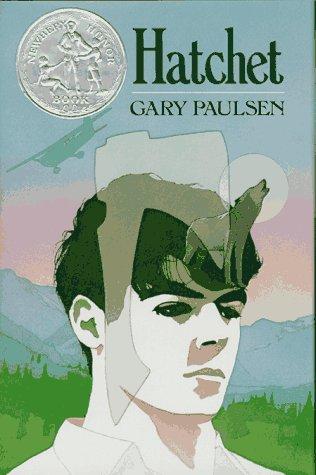
hatchet

Title: Hatchet by Gary Paulsen

Genre: Censored

Annotation: Armed with only a hatchet from his mother and haunted by the divorce of his parents, a boy must survive the wilds of Canada.

Review: Anyone who has ever witnessed the breaking up of one’s own parents’ marriage can certainly empathize with Brian Robeson’s angst over his mother’s infidelity (the secret) and his folks’ recent divorce. However, everyone can relate to his struggle to stay alive in the harsh Canadian wilderness after the pilot of the plane ferrying Brian to his father suffers a heart attack and leaves Brian to crash land the aircraft into one of the lakes that dot the unpopulated area. For better or worse, Brian survives the harrowing accident with only a small hatchet that his mother had given him for working with his father in the wilderness.

The description of surviving the crash was poignant, and it was replete with sensations basic to the human condition: pain, thirst, hunger, fear. Civilized man – or boy – was thrust into raw nature where he had to find the wherewithal to fend for himself and adapt to nature’s elements and attend to his body’s needs in order to survive. Remembering one of his former English teachers named Perpich, Brian attempted to stay positive and “get motivated” at the beginning of his fifty-four day adventure in the remote Canadian woods. Brian goes on to find shelter, locate food, face a bear, make fire, survive a tornado, and ultimately gain the strength to swim to the sunken plane, find a locater beacon and facilitate his own rescue.

Hatchet is a study in strength, whether physical endurance or the emotional fortitude to face one’s internal demons and fears. For instance, Brian found the inner strength to remain relatively calm after the pilot fell into unconsciousness. Luck or serendipity also played a role in the story. Brian was “lucky” that the pilot had given him a brief piloting lesson just before crash landing. Brian was also lucky when he found a lake in which to land the plane, a shelter that had been conveniently scooped out by glaciers past, various wilderness foods, and (lastly) the ultimate recovery of the survival packet that led to Brian’s rescue. Moreover, through his ordeal in the wilderness by the lake, Brian also learned the most important rule of survival: feeling sorry for oneself doesn’t work. And yet through this test of strength, of will, he had “died and been born as the new Brian.” In fact, it was this metamorphosis that ultimately allowed Brian to come to terms with the divorce, the “breaking word.”